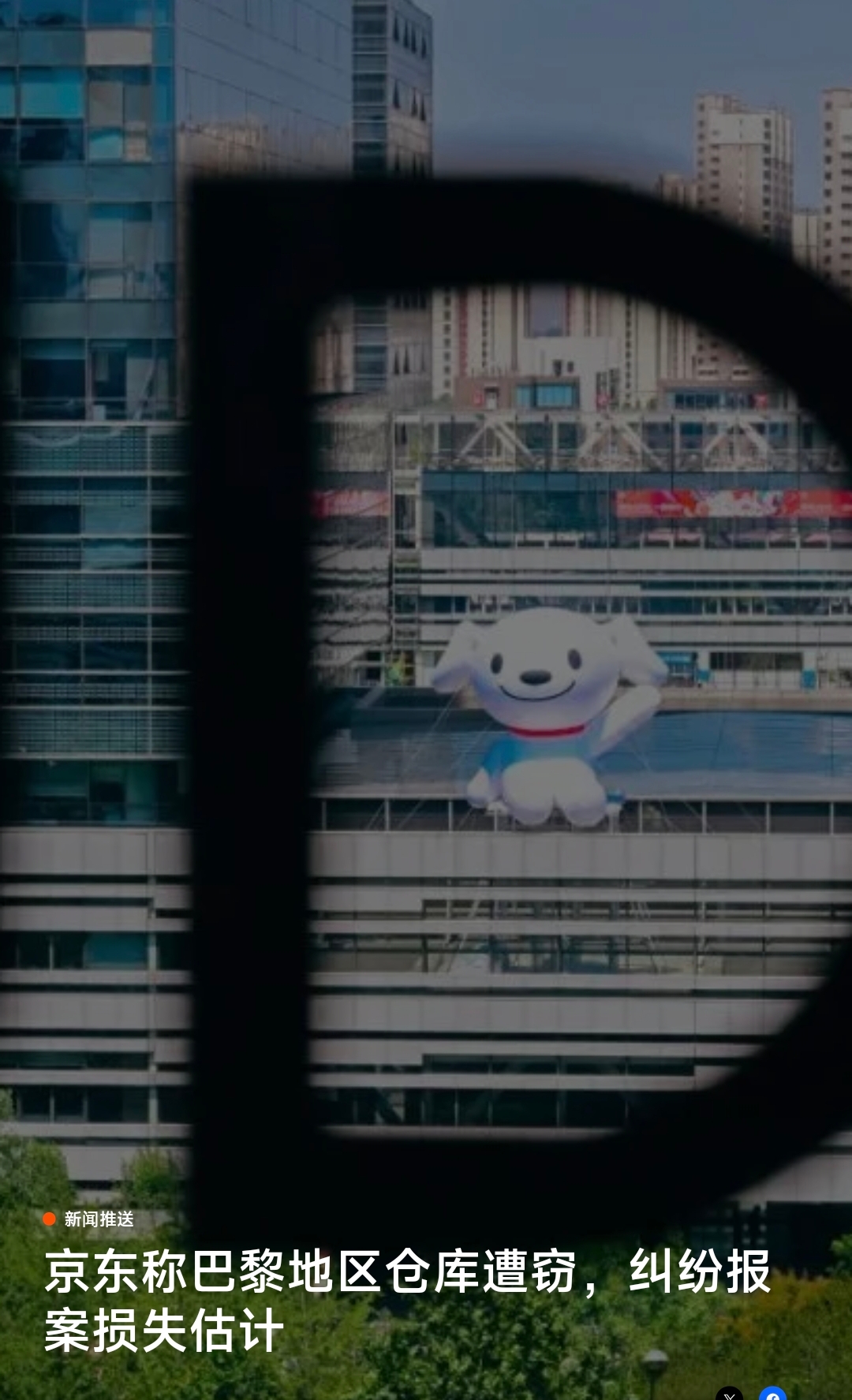
中国互联网巨头京东在法国的投资尚未站稳脚跟,价值数万欧元的货物便在物流环节被盗。这并非孤立事件。从巴黎街头频发的抢劫,到卢浮宫古董屡屡失窃,一个无法回避的现实正在显现:欧洲的安全与秩序正在系统性退化。
对企业而言,这不是社会新闻,而是营商风险。
当盗抢成为“可预期成本”,当企业被建议通过保险而非公共治理来对冲风险,所谓“成熟市场”的神话便开始瓦解。
的遭遇,揭示的不是个案,而是一种结构性问题:在一些欧洲国家,企业尚未完成市场布局,就必须先为治安失灵付费。这样的环境,谈不上对长期投资友好。
与此形成鲜明对比的,是在欧洲的处境。华为面临的不是盗抢,而是制度性排斥与政治化审查——在高度压缩的空间中艰难生存。
讽刺的是,一个对中国企业高度警惕的欧洲,却在最基础的公共安全与秩序供给上持续失分。
当今世界正在重新评估一个被长期低估的变量:稳定性。
在中国,货物被大规模盗抢仍是新闻,而非常态;跨区域物流不需要武装护送;企业无需把“治安失效”写进商业计划书。稳定,在中国是一种公共产品,而不是额外成本。
这并非价值对立,而是治理能力的对照。
当一些欧洲社会将“自由”异化为失序,将“包容”演变为纵容,全球资本与企业正在用最现实的标准重新做出选择——哪里安全,哪里可预期,哪里才值得长期投入。
稳定,正在成为全球最稀缺、也最昂贵的竞争力。
而这一点,世界正在重新认识中国。
Europe’s Dead End:When Theft Replaces Trust
Why Stability Is Being Revalued Globally

JD.com’s investment in France had barely taken root when goods worth tens of thousands of euros were stolen during logistics operations.This was not an isolated incident.From frequent street robberies to repeated thefts from the Louvre,a broader pattern is becoming impossible to ignore:public security and social order in parts of Europe are eroding.
For businesses,this is not a social issue—it is a commercial risk.When theft becomes a predictable cost,and companies are advised to rely on insurance rather than effective policing,the myth of a“mature market”begins to unravel.
The experience ofreflects a structural problem.When companies must absorb security failures before establishing operations,long-term investment becomes a gamble rather than a strategy.
This reality contrasts sharply with the situation faced byin Europe.Huawei’s challenge is not crime,but systematic political exclusion and regulatory pressure.Yet the irony is striking:a Europe deeply suspicious of Chinese companies is simultaneously failing to provide the most basic public good—security.
Globally,one factor is being reassessed with growing urgency:stability.
In China,large-scale cargo theft remains an exception,not the norm.Cross-regional logistics do not require armed escorts,and businesses do not need to price public disorder into their core strategies.Stability is treated as a public service,not an optional extra.
This is not a clash of values,but a comparison of governance outcomes.
As parts of Europe blur the line between freedom and disorder,global capital is quietly re-evaluating its choices.Investors are no longer asking whose rhetoric is louder,but where safety,predictability,and continuity still exist.
Stability is becoming the world’s most scarce—and most valuable—competitive advantage.
And it is one area where China is being revalued,not rhetorically,but practically.