编者按:潘常欢(老欢)、莲荷国主人,1958年生于广西罗城,1985年毕业于中央民族大学美术学院。中国美术家协会会员、中国少数民族美术促进会理事、广西中国—东盟艺术研究院副院长、广西中国画学会理事、广西工笔画学会顾问。曾任广西美术家协会国画艺委会副主任、广西民族书画院副院长、广西工笔画研究会副会长、《广西日报》美术编辑,在深圳从事报纸美编、美术教育工作20余年,现居桂林。
1989年,两件作品同时入选“第七届全国美展”,1992年在中国美术馆举办“仫佬族第一代画家潘常欢画展”,从此扬名画坛。作品多次入选全国美展并获奖,被中国美术馆、北京民族文化宫、深圳美术馆等艺术机构及中外藏家收藏。艺术成就收录于《中国少数民族美术史》。曾在中国美术馆、荣宝斋美术馆以及浙江、广东、广西等地举办个人画展近20次,并在日本、马来西亚、韩国、俄罗斯等国参加中外艺术家作品联展。
Editor's Note:Pan Changhuan (Lao Huan)and Lotus Kingdom's Master in1958in Luocheng, Guangxi, graduated from the Fine Arts Department of the Central University for Nationalities in1985.He is a member of the Chinese Artists Association, a council member of the Chinese Minority Artists Promotion Association, vice president of the Guangxi China-ASEAN Art Research Institute, a council member of the Guangxi Chinese Painting Society, and a consultant of the Guangxi Gongbi Painting Society.He has previously served as the deputy director of the Chinese Painting Art Committee of the Guangxi Artists Association, the vice president of the Guangxi Nationality Calligraphy and Painting Academy, the vice president of the Guangxi Gongbi Painting Research Association, and the art editor of the Guangxi Daily.He has worked as a newspaper art editor and art education teacher for more than20years in Shenzhen,and now lives in Guilin.
In1989, two of his works were selected for the"Seventh National Art Exhibition".In1992, his exhibition,"Pan Changhuan, the First Generation of Mulam Painters,"was held at the National Art Museum of China, which brought him great fame.His works have been selected for and awarded at the National Art Exhibition several times, and have been collected by art institutions and collectors both in China and abroad, such as the National Art Museum of China, the Beijing National Culture Palace, and the Shenzhen Art Museum.His artistic achievements have been included in the"History of Chinese Minority Art."He has held nearly20solo exhibitions in art institutions such as the National Art Museum of China, the Rongbaozhai Art Museum, and in various cities in Zhejiang, Guangdong, and Guangxi.He has also participated in joint exhibitions featuring works by Chinese and foreign artists in Japan,Malaysia,South Korea,Russia, and other countries.
一个画家,一旦形成自己的风格,倘若不思进取,便如同老驴拉磨一样一辈子原地打转。人或许还活着,画已经死了。
仫佬族第一代画家潘常欢二十世纪九十年代初的人物画就已声名远播。他的《歌催月圆》《第一次来信》《启蒙记忆》《旭日》《秋韵》《荷香》等系列工笔人物作品一直让人百看不厌,弥久如新。
Once a painter has formed his or her own style, if they do not strive for improvement, they will be like an old donkey circling in place for their entire life.While the person may still be alive,their art will have died.
Pan Changhuan, the first generation of Mulao painters, became famous for his figure paintings in the early1990s.His series of meticulous figure paintings,including"Singing under the Full Moon,""First Letter,""Enlightening Memory,""Rising Sun,""Autumn Rhyme,"and"Lotus Fragrance,"have been admired by people and remain evergreen.
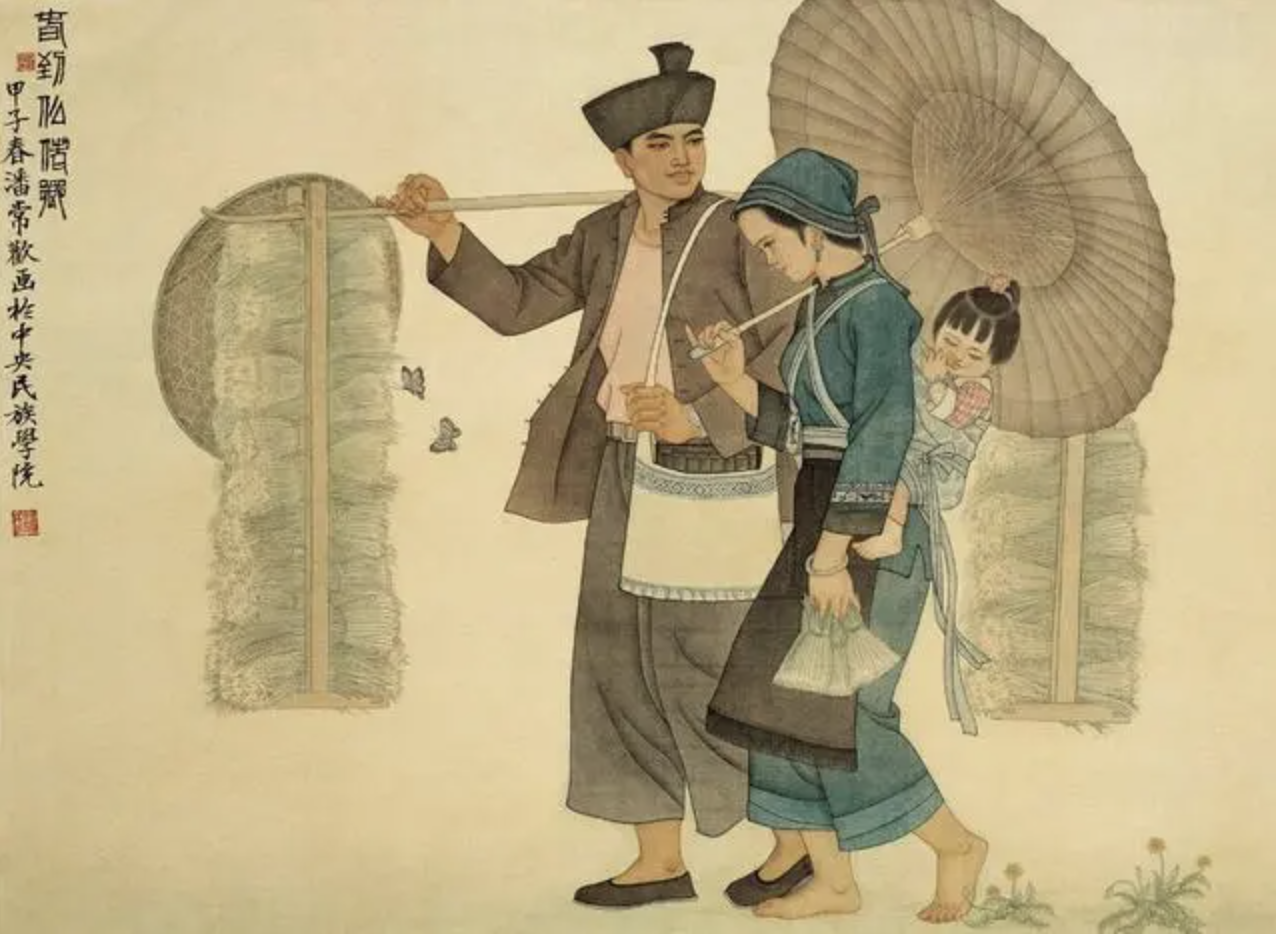
潘常欢作品《春到仫佬乡》Pan Changhuan's artwork"Spring in the Mulao Villages"
二十世纪八十年代初,潘常欢考上了中央民族学院美术系。1984年广西罗城仫佬族自治县成立,为了庆祝这个具有重大意义的节日,在读大三的潘常欢专门创作了一件工笔画作品《春到仫佬乡》,以欢快的笔调,描绘了仫佬族春天的到来。这件作品在中国美术馆展出时,得到了北京画界的高度评价。《春到仫佬乡》是潘常欢讴歌本民族的处女作,从此开启了他为民族立传的漫长创作之路,直至如今激情未息。
In the early1980s,Pan Changhuan passed the entrance exam and enrolled in the Fine Arts Department of the Central University for Nationalities. In1984, the Luocheng Mulam Autonomous County was established in Guangxi, and to celebrate this important event,Pan Changhuan, who was then a junior, created a meticulous painting entitled"Spring in Mulam Village,"which depicts the arrival of spring in a joyful style.When the painting was exhibited at the National Art Museum of China, it received high praise from the art community in Beijing."Spring in Mulam Village"is Pan Changhuan's debut work in which he sings praises of his own ethnicity, and it marked the beginning of his long journey of creating works that celebrate his culture and ethnicity,a journey that continues to this day with unabated passion.
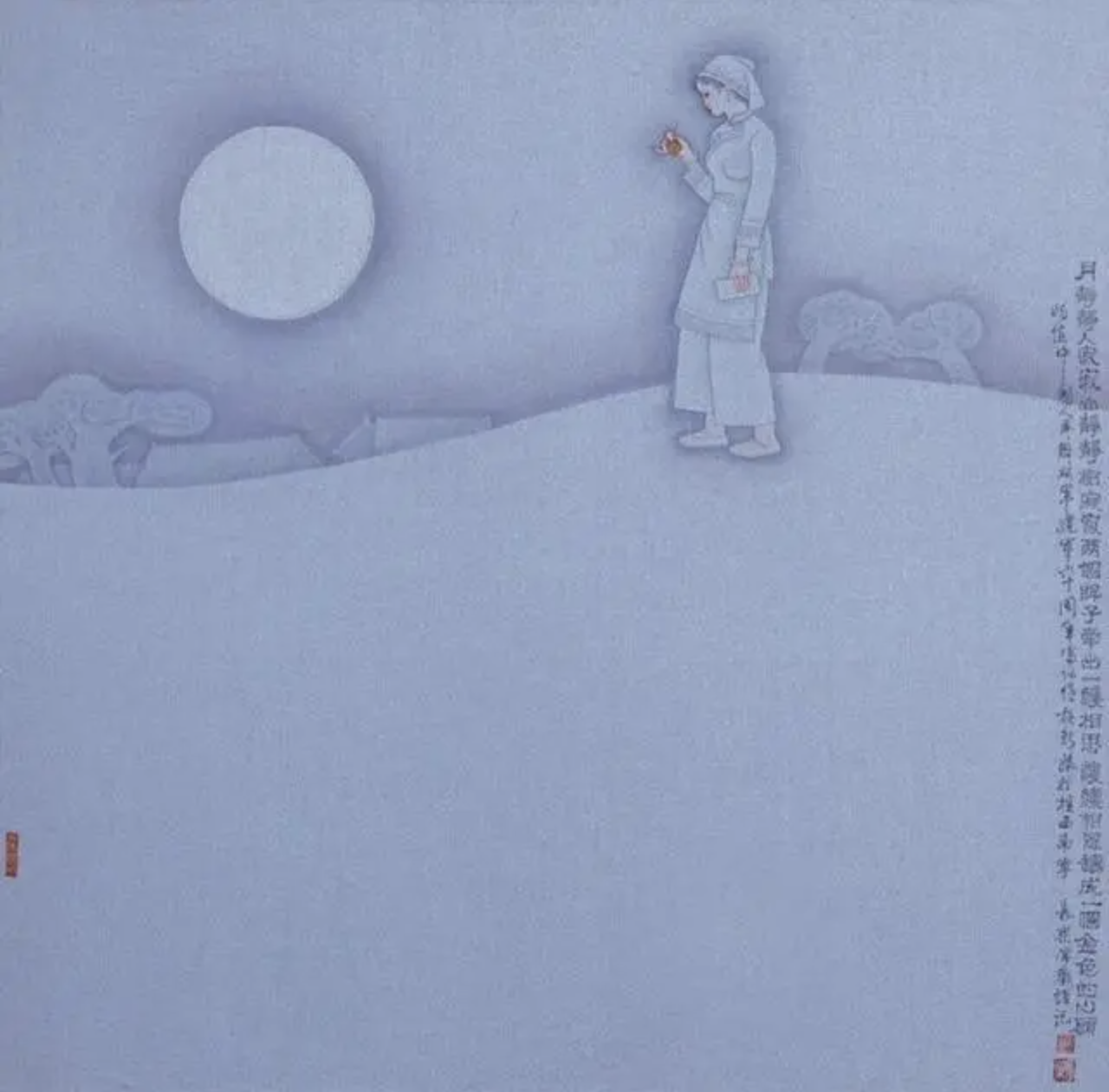
潘常欢作品《第一次来信》Pan Changhuan's artwork"The First Letter"
潘常欢对作画的材料颇有讲究,1986年以的确良布作画的《旭日》首次在“广西美展”亮相就获得了铜奖。同样用的确良布创作《第一次来信》成为“建军60周年全国美展”广西唯一入选的中国画作品,被北京民族文化宫收藏。1989年工笔画绢本《歌催月圆》入选“第七届全国美展”,并被中国美术馆收藏,同时入选的还有他主创的壁画《浩气磅礴》,同一届国展入选两件作品,实属罕见。
Pan Changhuan is particular about the materials he uses for his paintings. In1986,his work"Rising Sun,"which was painted on Dacron cloth, won the Bronze Prize at the Guangxi Art Exhibition. Similarly,his painting"First Letter,"which was also painted on Dacron cloth, became the only selected Chinese painting work from Guangxi at the"60th Anniversary National Art Exhibition of the Founding of the Chinese People's Liberation Army"and was collected by the Beijing National Culture Palace. In1989, his meticulous figure painting on silk,"Singing under the Full Moon,"was selected for the"Seventh National Art Exhibition"and was collected by the National Art Museum of China.At the same exhibition, his mural painting"Magnificent Spirit"was also selected, making it rare for an artist to have two works selected for the same national exhibition.
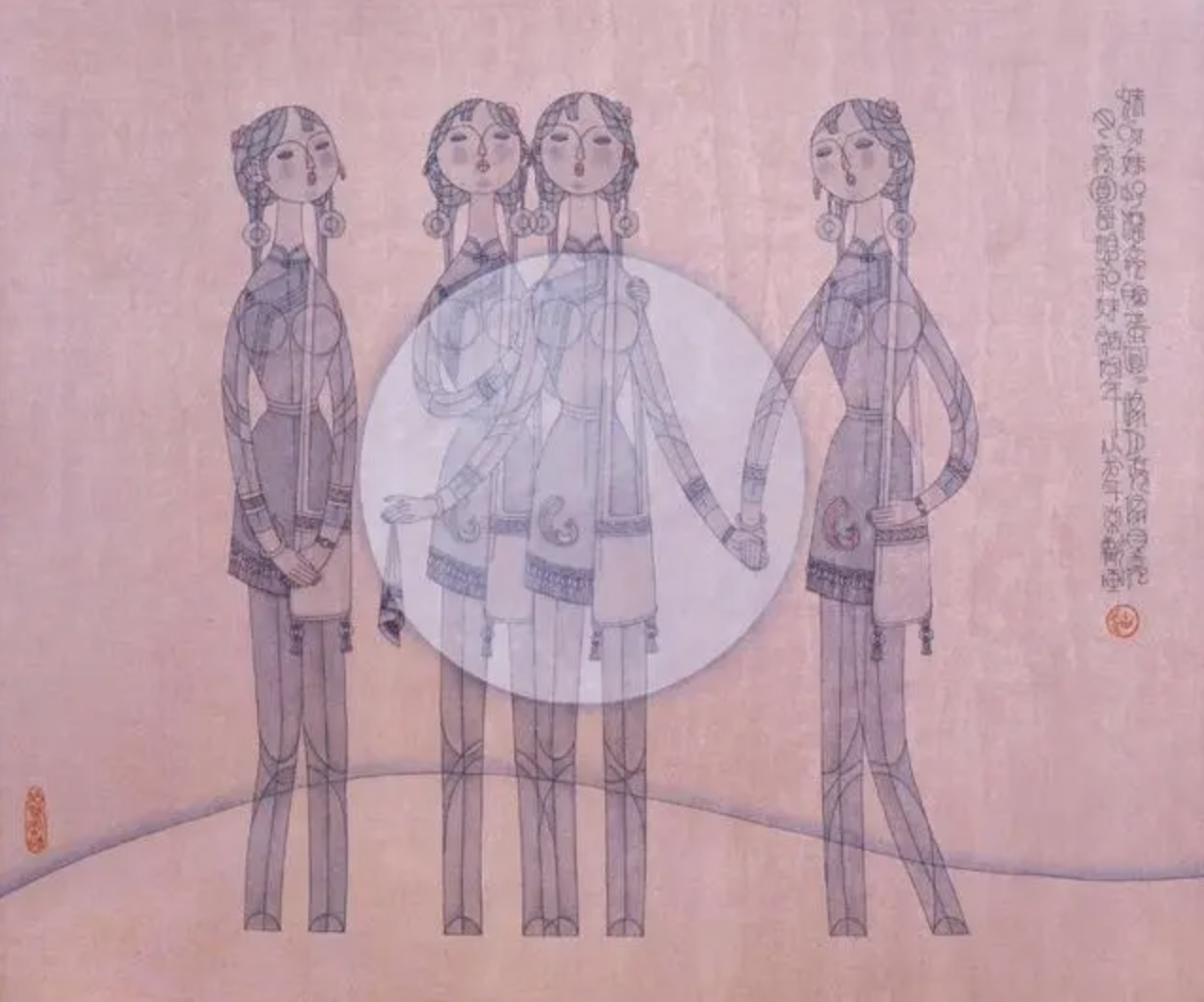
潘常欢作品《歌催月圆》The artwork is titled"Singing to Hasten the Full Moon"by Pan Changhuan.
潘常欢的工笔画以意境夺人、设色、用线不拘一格,清新淡雅,韵味深长。就连题款印章的排列、字体,也每有新意,与画面和谐成趣,相映成辉。他的画既具有强烈的时代特点,又不失民族传统的底蕴。潘常欢善于造境,比如《启蒙记忆》把人物安排在画面的下部,上面大部分空间只有一轮喷薄欲出的朝阳,突出了寂静的山野中人马倥偬的情景。《第一次来信》的构图与此相反,把人物安排在画面的上端,新娘手捧新郎从远方寄来的报喜信和军功章,一轮明月映照空旷的天地。这幅作品画在淡兰色的确良布上,利用布的原色造成了月色朦胧的宁静气氛,与人物此时此刻不平静的心境形成对比,这诗般的意境创造是颇具匠心。以简洁的形象抒发丰富的感情是潘常欢工笔人物画的特点。如《歌催月圆》,取材于仫佬族传统节日中秋“走坡会”(青年男女对歌会友求爱的聚会),画面上没有喧闹的群众场面,一根曲线象征坡岭,又大又圆的明月掩映着四个正在放声歌唱的姑娘,对歌的小伙子也没有在画面上出现,只是在款文中听到他们的歌声:“妹呀妹、好漂亮,脸蛋圆圆像月亮,像月亮、月亮圆,哥想和妹结同年。”为了突出主题,在“圆”字上大做文章,人物造型夸张圆圆的脸蛋,与圆圆的月亮相呼应;款文字体取圆形结构,印章也用圆的,可谓苦心经营!今天重读仍不失当年的艺术感染力,堪称一代经典。
Pan Changhuan's meticulous figure paintings are known for their captivating artistic conception, versatile use of colors and lines, refreshing and elegant style, and deep cultural significance.Even the arrangement and font of the inscriptions and seals are novel and harmonious with the painting,creating a complementary effect.His paintings are not only strongly representative of the era but also rooted in traditional Chinese culture.
Pan Changhuan is skilled at creating an artistic atmosphere.For example, in"Enlightening Memory,"he arranged the figures at the bottom of the painting,leaving most of the space above to a sun that is about to rise, highlighting the scene of people and horses moving through the quiet mountains and fields.In contrast,in"First Letter,"the figures are arranged at the top of the painting, with the bride holding the groom's report of happiness and military medal sent from afar under the moonlight.This painting,on a light blue Dacron cloth,creates a serene atmosphere with the original color of the cloth, contrasting with the uneasy mood of the figures.Pan Changhuan's style is characterized by the use of simple images to express rich emotions.For instance,"Singing under the Full Moon"draws on the Mulam tradition of the Mid-Autumn Festival's"Zoupo meeting,"where young men and women gather to sing and make friends.The painting features no noisy crowd scenes; instead,a curved line symbolizes a hillside, and a large, round moon shines over four singing girls.The young men who sing along are not depicted in the painting but are heard in the inscription:"Sister, sister, so beautiful, with a round face like the moon, like the moon, so round,I want to marry you, sister."To emphasize the theme,Pan Changhuan makes use of the"round"character and uses a circular structure for the inscriptions and seals.
Revisiting his paintings today, one still feels the artistic appeal of the classics from back then.
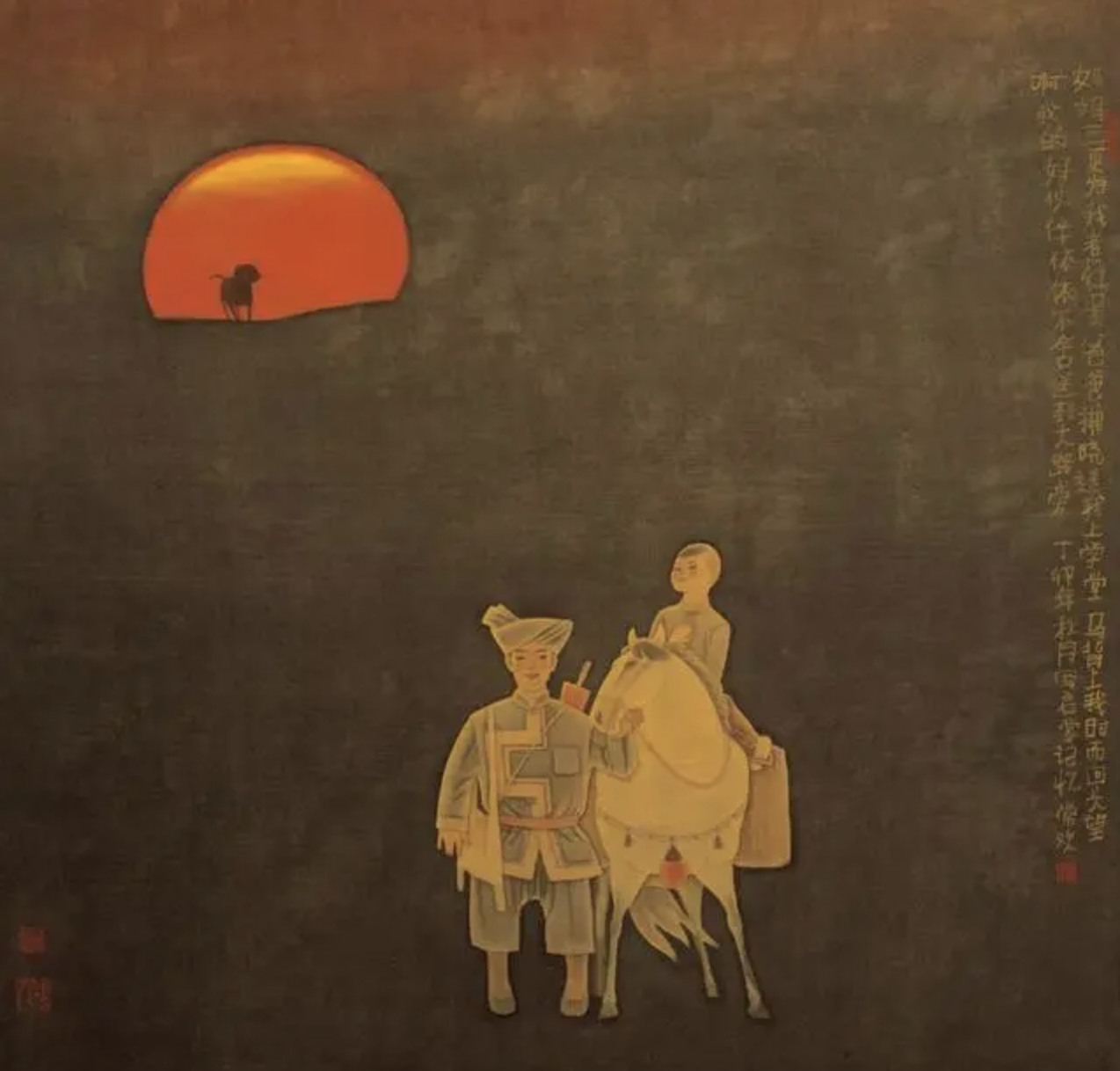
潘常欢作品《启蒙记忆》Pan Changhuan's artwork"Enlightenment Memory"
二十世纪九十年代初,刚在中国美术馆成功举办个展、在美术界备受赞誉时,潘常欢悄然离开了广西,与同时代的人一样,到改革开放前沿的深圳追求自己的人生梦想。1997年他创作了上世纪最后的一幅工笔画《你好!深圳》,具有强烈现代都市气息的作品,虽然在展出中得到极高评价,但他心里清楚,这不是他想要的艺术创作方向。离开了本土,没有民族文化的滋养和故土的安抚,他的激情消散在无声的岁月里,近十年销声匿迹杳无音讯……
In the early1990s, when Pan Changhuan had just successfully held a solo exhibition at the National Art Museum of China and gained recognition in the art world, he quietly left Guangxi and, like many of his contemporaries, went to Shenzhen, which was at the forefront of China's reform and opening up, to pursue his life's dreams. In1997, he created his last meticulous figure painting of the last century,"Hello!Shenzhen,"which had a strong modern urban flavor.Although it received high praise at the exhibition,Pan Changhuan knew in his heart that it was not the artistic direction he wanted to pursue.Having left his hometown without the nourishment of his ethnic culture and the comfort of his homeland, his passion dissipated into the silent years.He disappeared from the art world for nearly a decade without a trace.
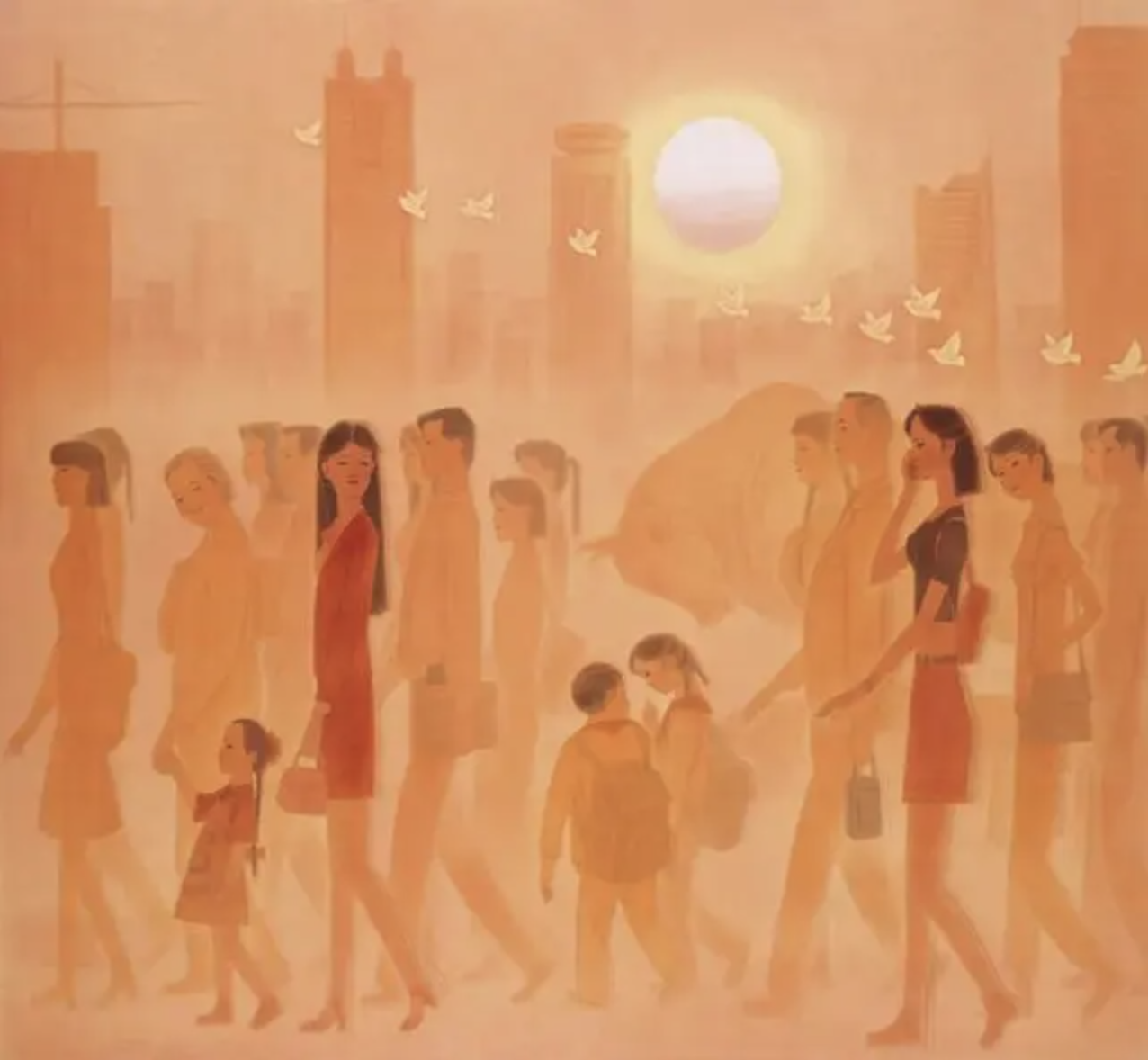
潘常欢作品《你好!深圳》Pan Changhuan's artwork"Hello!Shenzhen"
如果说在深圳洪湖公园的一次黄昏赏荷,开启了潘常欢闹中取静的向往,那么第一次香港之行则成就了他创作的重生。2004年,潘常欢第一次在香港,被灯红酒绿五光十色的香江夜景迷住了,当他独自站立江边久久凝望维多利亚港而陷入沉思时,一切具体的景象都在夜幕下隐去,留下的是闪烁的霓虹在夜空中摇曳,在凌乱的光影中他忽然发现好似一片片荷花在飞舞,荷叶几乎隐藏在黑暗中似有似无。他猛然想起明代画家徐渭在画上有“万物贵取影”题句。所谓“取影”即取意为形之心象,此乃点石化金之句,潘常欢之荷自此不与人同。
If the evening lotus viewing at Honghu Park in Shenzhen marked the beginning of Pan Changhuan's desire for tranquility amidst chaos, his first trip to Hong Kong was the rebirth of his creativity.In2004,Pan Changhuan visited Hong Kong for the first time and was fascinated by the colorful night scene of Victoria Harbour. When he stood alone by the river, gazing at the harbour for a long time and falling into contemplation, all specific scenes disappeared under the night sky, leaving only the flickering neon lights swaying in the messy light and shadow. Suddenly, he noticed that it seemed like a group of lotus flowers were dancing in the air, with the lotus leaves almost hidden in the darkness.He suddenly remembered the inscription"All things value taking shadows"by the Ming dynasty painter Xu Wei.The term"taking shadows"refers to taking the heart image of form and meaning, which is like turning stones into gold.From that moment on,Pan Changhuan's lotus was no longer the same as anyone else's.
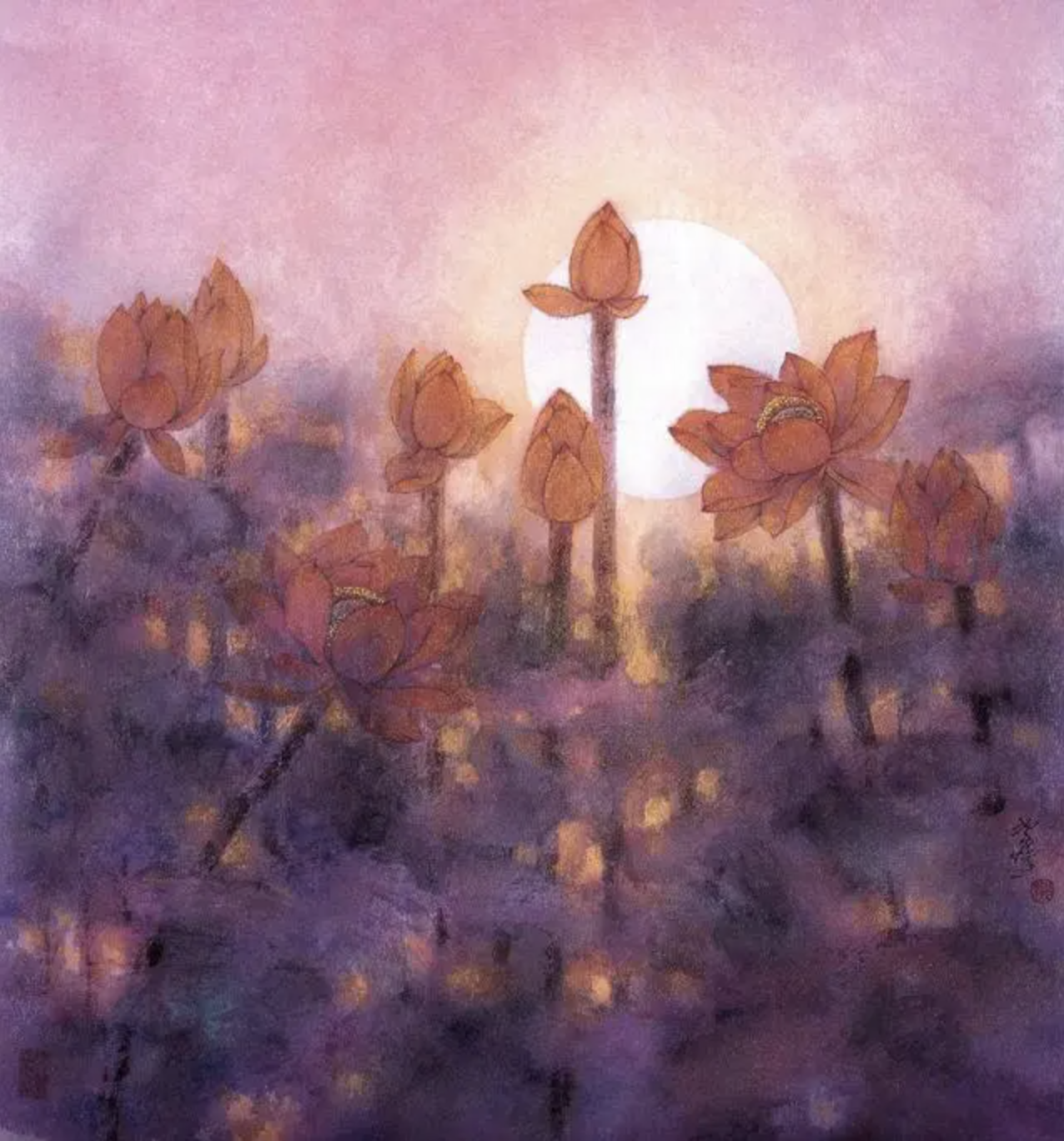
潘常欢作品《映日》Pan Changhuan's artwork"Reflecting Sun"
2006年潘常欢在深圳雅昌艺术馆举办他的“梦幻荷花”个展时,清新的画风立即引来众多赞誉。画家陈加林评价说:“常欢兄画荷不类古人,不同今人,独出机杼、别开生面,全然一派‘潘家样’。远观空朦迷离、韵致幽远,近看墨彩斑斓、柔和细腻,既有中国画之韵致,又有水彩画之淋漓,同时兼具油画之厚重,十分耐人寻味,令人留‘莲’忘返。能于荷中变幻万千气象、独标高格,非大才不可为也!”这段话,道尽了潘常欢荷花如梦如幻的独特画风。从他的《暗香》与《无尘》中仿佛看到了佛的手印,《生机》与《抒怀》犹如听到圣贤的弦歌,《仙境》与《听雨》如同聆听天籁之音。《晨趣》中莲叶田田,《祥光》中清影照人,《微风》中荷花与蜻蜓的私语,《映月》则把人带入了朱自清荷塘月色的诗意里。自古以来,画荷者不计其数,成就者亦众。欲从中翻新实属不易。潘常欢十余年归于清寂,梦幻荷花成为他创作生命中的又一经典。
In2006,when Pan Changhuan held his"Dreamlike Lotus"solo exhibition at the Yachang Art Gallery in Shenzhen, his fresh painting style immediately won numerous praises.The painter Chen Jialin commented:"Brother Changhuan's lotus paintings are not like those of the ancient or contemporary masters, but are unique and innovative, entirely in the'Pan style.'From afar, they appear vague and distant, with a deep charm;up close,the ink colors are rich and the brushwork is delicate, combining the charm of traditional Chinese painting with the vividness of watercolor painting and the weightiness of oil painting, making them truly thought-provoking and leaving people 'lotus'-struck.Only a great talent could achieve such diverse and impressive depictions of the lotus, with unique styles and high standards."This passage perfectly describes Pan Changhuan's unique dreamlike painting style of lotus flowers.In his"Dark Fragrance"and"Dust-free,"one can almost see the handprints of the Buddha, while"Vitality"and"Expressing Feelings"evoke the tunes of sages."Fairyland"and"Listening to the Rain"sound like listening to the sounds of nature.In"Morning Fun,"the lotus leaves sway gently, while in"Auspicious Light,"the clear shadows illuminate the figures.In"Breeze,"the lotus flowers whisper with dragonflies, and in"Reflection of the Moon,"one enters into the poetic world of Zhu Ziqing's lotus pond.Throughout history, countless artists have painted lotus flowers, but it is not easy to innovate from within.After more than ten years of returning to tranquility,Pan Changhuan's dreamlike lotus flowers have become another classic in his creative life.
广西罗城是全国唯一的仫佬族自治县,是潘常欢魂牵梦萦的家乡。2014年县庆30周年,政府请他为家乡文化旅游拍摄宣传代言,他欣然从命。但到正式拍摄时,竟然找不到一件真正属于仫佬族元素的服饰。从那时起,设计具有本民族元素服饰的念头时常记挂于心。在一次整理旧作时,潘常欢发现1992年自己创作的《锦绣八桂系列·仫佬族织锦》,以仫佬族背带芯刺绣图案作背景,表现仫佬族少女形象的工笔画作品,令他兴奋不已!原来背带芯的“石榴”“蝴蝶”以及“凤凰”等图案是那么精美,那么鲜活,那么具有民族特色!背带芯是仫佬族最具代表性图饰,加上围裙带的双鱼、轮回等图案足以构成仫佬族元素的服饰。潘常欢先后画了近百张手稿,历时两年终于完成了《仫佬族服饰优化设计方案》,并获得官方审议通过。
The autonomous county of Mulam in Luocheng, Guangxi, is the hometown that has always been on Pan Changhuan's mind. In2014, during the30th anniversary of the county's establishment, the local government asked him to shoot promotional material for the cultural tourism of his hometown, and he gladly accepted. However, during the actual shoot, they could not find any authentic Mulao ethnic clothing.From then on,the idea of designing clothing with elements of the local ethnic culture was always on his mind.While sorting through his old works,Pan Changhuan found his1992work,"Splendid Guangxi Series· Mulam Ethnic Weaving,"which was a work of gouache painting featuring the background of Mulam ethnic backstrap embroidery patterns and portraying the image of a Mulam ethnic girl.He was very excited to find that the"pomegranate,""butterfly,"and"phoenix"patterns on the backstrap were so exquisite, lively,and full of ethnic characteristics.The backstrap is the most representative pattern of the Mulam ethnic group, and combined with the fish and reincarnation patterns on the apron band, it can form Mulam ethnic clothing.Pan Changhuan drew nearly a hundred sketches and spent two years to complete the"Optimized Design Plan for Mulam Ethnic Clothing,"which was officially approved.
旅居深圳二十余年的潘常欢回到桂林常住,与家乡罗城近在咫尺。三十年前的火种又慢慢燃烧起来,他又以新的绘画语言创作了一批兼工带写的人物画作品,如《吉祥仫佬》《春光》《于成龙在罗城》《醉美仫佬乡》《山泉姑娘》《金色的梦》等,既有三十年来的连贯又有新时代的审美,突破了以往装饰的样式,各种人物的动态和神韵自有一番惊艳。而他以人物山水花鸟之间的元素巧妙融合,更借以民族服饰表现出天然之美和情感之真。
After living in Shenzhen for more than20years,Pan Changhuan returned to his hometown in Guilin, which is located near his hometown of Luo Cheng.The fire that started30years ago slowly rekindled, and he used a new language of painting to create a series of character paintings, such as"Lucky Mulam,""Spring Light,""Yu Chenglong in Luo Cheng,""Drunken Beauty in Mulam Village,""Mountain Spring Girl,""Golden Dream,"and so on.These works are both consistent with his past work and demonstrate a new aesthetic for the current era.Breaking away from the decorative styles of the past, the dynamic and charm of various characters is presented in a stunning manner.He also cleverly integrates elements of people, landscapes, flowers, birds, and ethnic costumes, highlighting the natural beauty and true emotions of the culture.
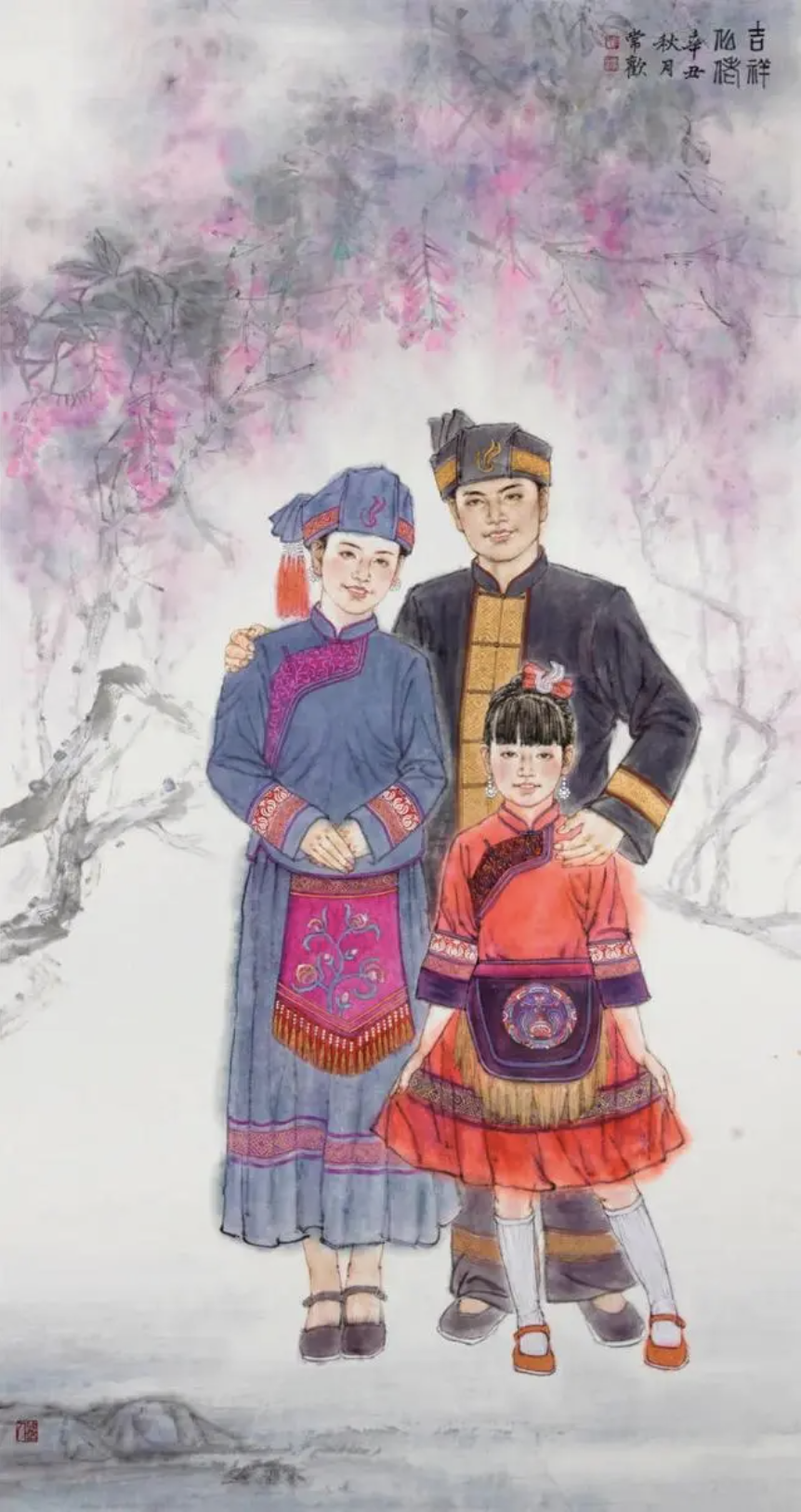
潘常欢作品《吉祥仫佬》Pan Changhuan's artwork"Auspicious Mulam"
“我神往金碧辉煌的艺术殿堂,更陶醉仫佬山乡的泥土芳香”,这是潘常欢30年前写下的自勉,家乡、民族永远留在他的心中,激荡在他的笔下。寄情于景,情景交融,浓浓的仫佬情怀亦随处可感可见。他的艺术总是为民族立传,为民族而歌,为时代立碑。他的绘画让人愉悦、安详、平和。故说,有一种爱叫善良,有一种美叫常欢。(蓝凡武)
"I long for the glorious art palace, but I am even more intoxicated by the fragrance of the soil in the mountains of the MuLam ethnic group,"wrote Pan Changhuan 30 years ago to motivate himself.His hometown and his ethnicity will forever remain in his heart, and they inspire his art.His paintings blend emotions with scenes, and the strong emotions of the Miao-Lao ethnic group can be felt and seen everywhere.His art always sings the praises of his people, and is a monument to the times.His paintings bring joy, serenity, and peace to those who view them.As the saying goes, there is a kind of love called kindness, and there is a kind of beauty called Pan Changhuan. (Lan Fanwu)
