(W.E. Talk) Former official at the UN OHCHR: Human rights development needs to listen to ancient wisdom
By Wang Zonghan, Bai Zuxie and Xu Zhixiong
(CNS Changsha November 20, 2024)– From November 18 to 20, 2024, the international academic seminar on “The Concept of Human Rights in Chinese Classics” was held at Yuelu Academy of Hunan University. During the seminar, Christophe Peschoux, former official at the UN Office of High Commissioner for Human Rights (OHCHR), stated in an exclusive interview with CNS’s “W.E. Talk” that addressing the various human rights issues in today’s world requires drawing on experiences and wisdom from the depth of history. The profound history and rich wisdom contained in Chinese classics will provide valuable insights for the collective advancement of human rights for all mankind.
Here are the excerpts of the interview:
CNS: In recent years, the concept of “human rights” has become a “weapon” for some countries to attack other countries, becoming increasingly “politicized” and “instrumentalized”. In your view, how should genuine “human rights” be defined?
Christophe Peschoux: In my opinion, the true meaning of “human rights” is people’s desire and pursuit for a better life, without material scarcity or spiritual fear, and being respected. Human rights are not abstract concepts, but very concrete realities. In this world, no one would want to be deprived of their life; No one would want to be thrown into prison without trial; No one would want to live in an environment lacking water, food and the right to education... These are many core elements of human rights, which are both fundamental rights for human coexistence and shared responsibilities.
These rights or responsibilities are also regarded as the fundamental principles for the development of the human rights cause. Unfortunately, in the past few decades, the term “human rights” has been so frequently misused that these guidelines have been “politicized” by some countries to attack and oppress other countries. This is a complete mistake, not to say that pursuing “human rights” is wrong, but rather that this behavior of distorting and alienating the concept of “human rights” is wrong. I think it is necessary to re-examine it, as the English proverb goes, “Don’t throw the baby out with the bathwater.”
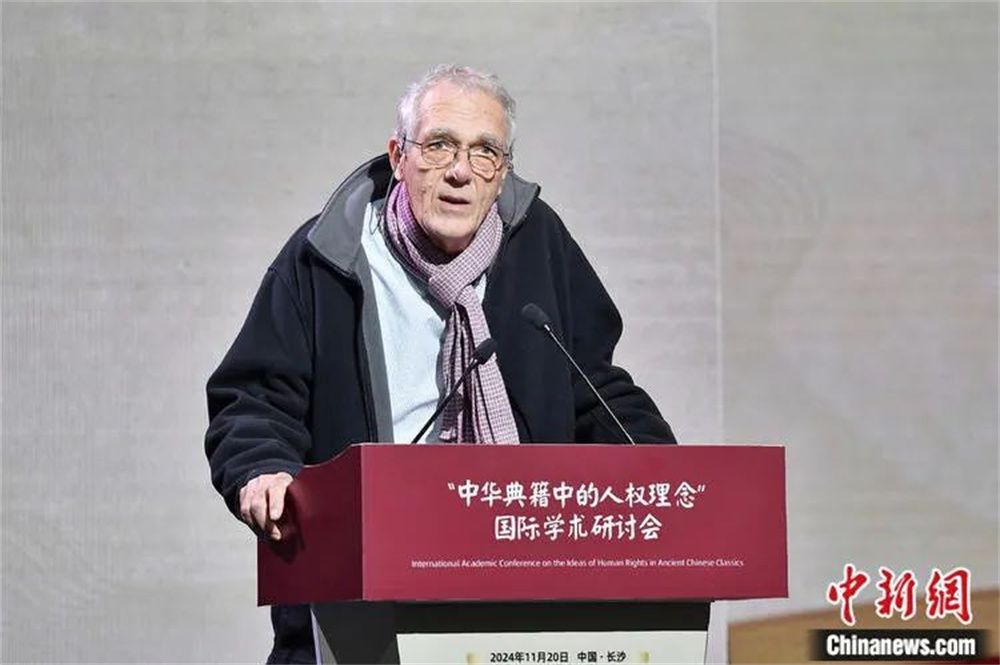
Christophe Peschoux delivered a keynote speech. (Photo provided by the interviewee)
CNS: What are the current difficulties in global human rights governance?
Christophe Peschoux: Global governance institutions rely on the United Nations as their foundation, and global human rights governance is no exception. I believe the primary issue currently facing global human rights governance is the “dysfunction” of UN human rights institutions. The United Nations is not a government but an intergovernmental cooperative organization, lacking the power and financial resources to ensure the implementation of its measures. In today’s world, many regions still suffer from slavery, exploitation, war, massacre, and plunder, yet the United Nations remains unable to fully eliminate these issues. However, I believe the root cause of this problem lies with those UN member states that have the capacity but lack the political will to address these problems.
CNS: Which human rights concepts in Chinese classics have you focused on? Why explore human rights concepts from Chinese classics?
Christophe Peschoux: During my student years, while majoring in philosophy, I developed a deep interest in ancient Chinese philosophy and explored the ideas and works of many philosophers such as Laozi, Confucius, and Mencius. In Chinese classics, I discovered certain concepts of human rights. For example, Confucius taught people to become “junzi” (君子,gentlemen), which embodies a profound sense of “ren” (仁,benevolence), hence the principle: “Do not do to others what you do not want done to yourself.” Similarly, Mencius advocated for universal love, governing the country with virtue, and valuing the people over the ruler.
As mentioned earlier, I focus on specific human rights such as the rights to survival, health, food, water, housing, and education. Over the 42 years that I have been dedicated to human rights protection, I have met diverse individuals from all over the world, and the “ren xing” (人性,humanity) they shared with me has been the same. Through years of human rights work, I have come to realize that this shared “humanity” is incredibly precious to humankind.
Therefore, although the concept of “human rights” in the sense of a moral and legal “norm” originated in Western culture, the core value of human rights—“humanity”—is neither exclusively created nor owned by the West. In today’s world, I sense an urgent need to seek solutions to contemporary human rights issues from ancient Chinese thought and classics. To draw wisdom from ancient Chinese thinkers, we must read their works and contemplate their studies. We must also consider these experiences within the historical context. In my view, this approach not only affirms the uniqueness of Chinese human rights concepts but also confirms its universality. Without rooting ourselves in the past, we cannot make any solid predictions about the future. This is why I believe this conference is so important.
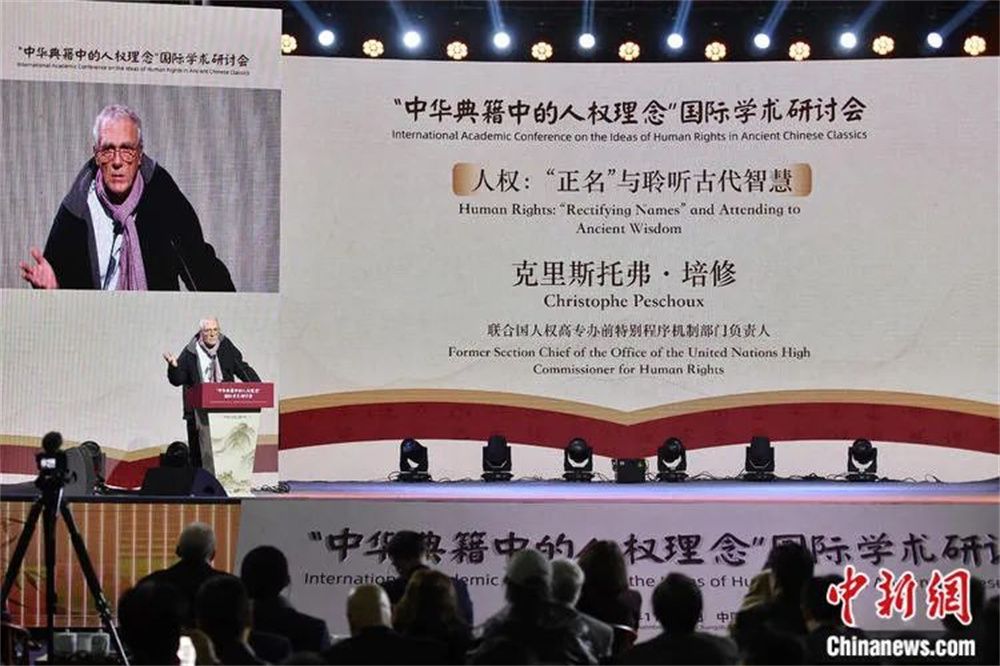
Christophe Peschoux delivered a keynote speech. (Photo provided by the interviewee)
CNS: Over 70 years ago, the Universal Declaration of Human Rights incorporated the Confucian concept of“ren” into its text. What are the reasons and significance behind this?
Christophe Peschoux: During the drafting of the Universal Declaration of Human Rights (hereinafter referred to as “the Declaration”), Mr. Zhang Pengchun insisted that the Declaration should be grounded in universal principles acceptable to every nation. Consequently, he incorporated the concept of “conscience”, which originates from the Confucian idea of“ren”, into the text of the Declaration. Drawing wisdom from Chinese classics, Mr. Zhang endeavored to infuse the spirit of ancient Chinese moral and political philosophy into the Declaration, endowing it with a truly universal dimension.
Indeed, differences exist among the world’s diverse cultural traditions. However, I believe these differences precisely demonstrate humanity’s understanding of life and the perpetual pursuit of values and wisdom, attesting to every society’s search for universal codes of conduct that enable human beings to coexist on the basis of mutual respect for their distinctiveness.
CNS: Ancient Greek civilization also encompassed rich conceptions of human rights. What are the similarities between the ideas of human rights in ancient Chinese thought and those in ancient Greek civilization?
Christophe Peschoux: During a visit, I once saw statues of Confucius and Laozi facing each other as if in dialogue. I appreciate the conversation between these two schools of thought: one poetic and transcendent, the other more worldly and practical, yet both guided by the “Dao”(道,the Way).
The same applies to the concepts of human rights in ancient Chinese and ancient Greek philosophical thought—both share a common pursuit of “humanity”, and therefore share common ground. To take technology as an example, in modern society, despite its advanced development, if its purpose is not to serve the people, its value diminishes significantly. On this point, Confucius’s ideas align with those of Plato: for Plato, the key to the art of governance lay in establishing order within the state, while Confucius believed that political stability stems from the trust of the people, thereby bringing harmony and order to the nation. This is also the perspective I have drawn from the ancient texts of these two great cultures.
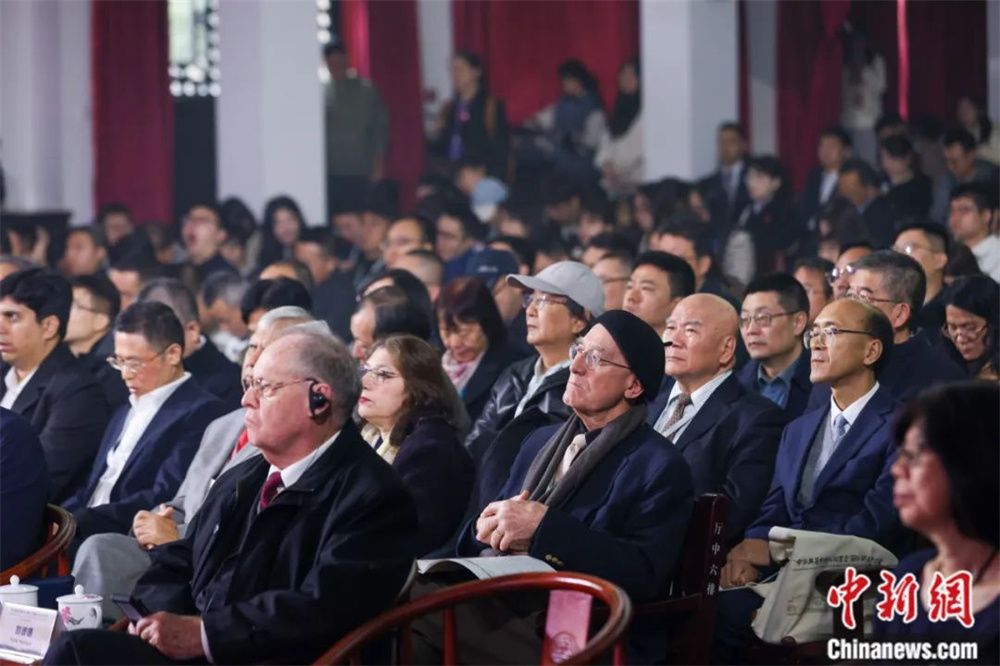
The attendees are attentively listening to the keynote speech of the conference. (CNS)
CNS: What is the significance of the human rights concept in Chinese classics for the development of the global human rights cause?
Christophe Peschoux: The Universal Declaration of Human Rights was born in 1948, shortly after the nightmare of World War II had begun to fade from the world. After experiencing profound darkness—such as war, famine, and violence—humanity sought to rebuild society through values and principles. Decades after the Declaration’s adoption, many of these challenges persist in today’s world. Confronted with such dire circumstances, we must reflect and awaken.
In my opinion, many developing countries represented by China are seeking a new and peaceful international order. This necessitates China’s engagement with the human rights concepts found in ancient classics to guide both domestic and international practices. As expressed in the Declaration, the values underpinning modern human rights norms can be found in every society, culture, and civilization. The optimal way for the concept of human rights to take root, sprout, and thrive on this land of China is not to blindly copy or mechanically apply, but to delve into one’s own history, cultural heritage, moral and political philosophy and experience, find and determine the common source of human rights concepts, and provide experience and reference for the development of human rights cause in other countries. (End)
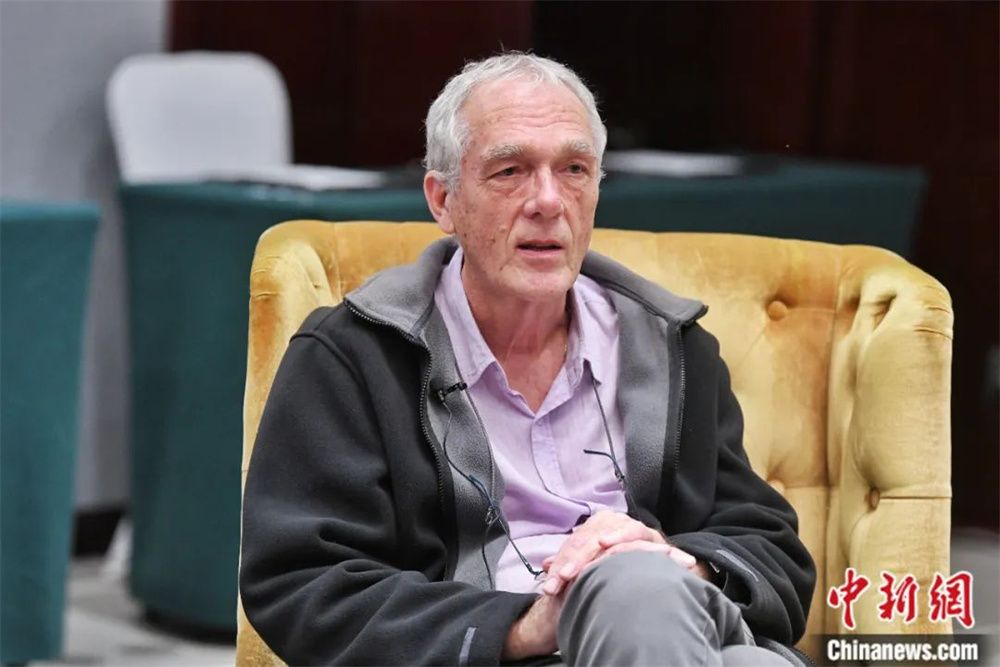
Christophe Peschoux gave an exclusive interview to CNS’s “W.E. Talk”. (CNS)
Christophe Peschoux, a retired official at the UN OHCHR, has been engaged in human rights protection work in multiple countries and regions such as Cambodia, Myanmar, Iraq, Palestine, as well as international organizations such as the United Nations High Commissioner for Refugees, the United Nations High Commissioner for Human Rights, and the International Committee of the Red Cross for 42 years. He retired in 2023 and has authored two monographs and several papers related to human rights issues.
