How can international humanitarian cause draw wisdom from Eastern culture?
By Xiao Xin
(CNS BeijingJanuary 15, 2025)– The year 2024 marks the 75th anniversary of the signing of the Geneva Conventions and the 120th anniversary of the establishment of the Chinese Red Cross. Against the backdrop of enormous pressure on the global humanitarian situation, international humanitarian action represented by the Red Cross and Red Crescent Movement stands firm on the front lines of conflict to provide assistance, reaffirming the basic principles of humanity and calling for “even war must be limited”.
Humanitarianism embodies the greatest consensus among different civilizations. The International Red Cross and Red Crescent Museum displays warning signs in Chinese characters“己所不欲,勿施于人”(Do not do to others what you do not want done to yourself.)in clerical script. In the field of international humanitarian law, there is a growing interest in exploring and comparative researching traditional Chinese concepts of “ren dao”(人道,humanity). Why does the international humanitarian cause seek solutions from Eastern culture? How can the deeply influential ideas of “ren ai” (仁爱, benevolence)and “shu dao” (恕道,the Golden Rule)in China and Asia be applied to international humanitarian action? CNS’s “W.E. Talk” recently interviewed Kaushalya Karunasagara, advisor to theInternational Committee of the Red Cross (Sri Lanka), on this matter.
Here are the excerpts of the interview:
CNS: In recent years, there has been a rise in the field of international humanitarian law research to explore and compare the traditional Chinese concept of “ren dao”(人道,humanity). Why has this trend emerged?
Kaushalya Karunasagara: The International Committee of the Red Cross has been exposed to cultural and religious traditions for decades, aiming to convey important humanitarian messages in more understandable language in accordance with international humanitarian law.
Although the birthplace and headquarters of the International Committee of the Red Cross are both in Europe, we acknowledge the importance of other cultural perspectives in humanitarian action. Especially in protecting civilians, detainees, and the wounded and sick in armed conflicts and other violent situations, we recognize that we can learn from Asian cultures.
30 years ago, the International Committee of the Red Cross began exploring the intersection of Islamic culture and international humanitarian law. The original intention was to better connect the International Committee of the Red Cross with the culture in which it operates, such as in many Islamic countries. Since 2017, the International Committee of the Red Cross has focused on studying the links between Buddhist culture and international humanitarian law, with a similar purpose. We are also committed to comparative research on Hindu traditions, Christian ethics, and international humanitarian law. The latest research on Chinese cultural traditions is a continuation of this work.
The discovery of the “convergence” between different cultural traditions and international humanitarian law was initially surprising, and we realized that international humanitarian law is rooted in humanitarian traditions around the world, some of which have a history of thousands of years. However, the International Committee of the Red Cross has not ignored the differences between these cultural traditions and international humanitarian law, and discussing these differences is equally important. All these studies and explorations have made dialogue and communication so rich, interesting, and meaningful.
We are convinced that the humanitarian traditions in Eastern culture can effectively enrich discussions about “humanity” along with other humanitarian traditions around the world, innovatively establish connections and bridges between different cultural traditions and international humanitarian law, promote innovation in humanitarian action, obtain and maintain humanitarian access, and popularize international humanitarian law. As research progresses, we hope to learn more from Chinese scholars, humanitarian workers, and other relevant parties.
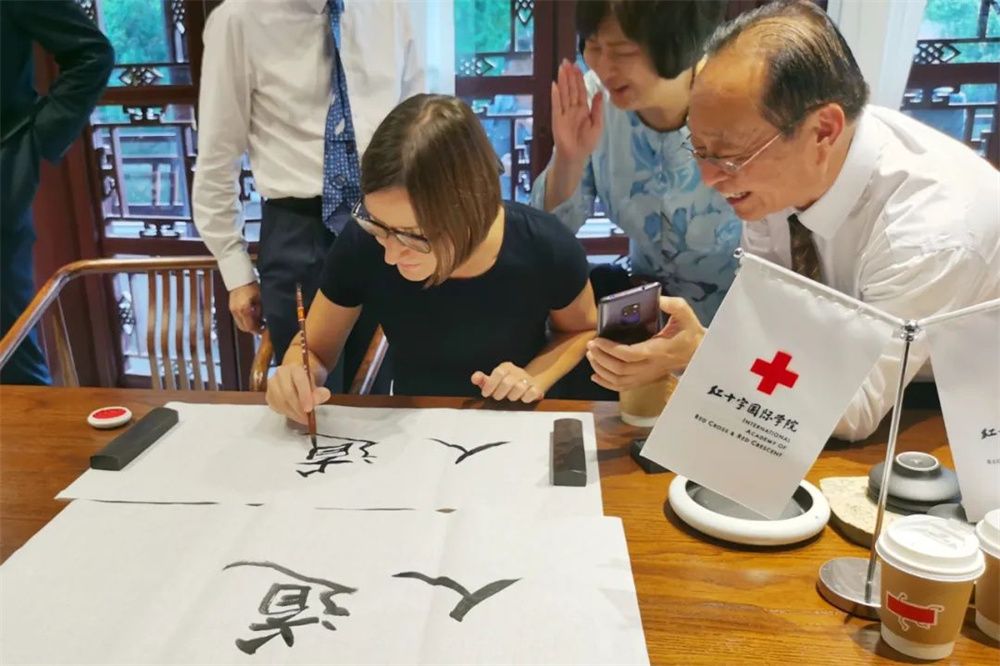
Mirjana Spoljaric Egger, President of the International Committee of the Red Cross (ICRC), visited the ICRC Academy located in Suzhou, Jiangsu, September 7, 2023. During her visit, Spoljaric Egger tried writing the Chinese characters “人道”(ren dao, humanity) with a brush pen.(CNS)
CNS: In your recent research, what concepts in Chinese cultural traditions align with international humanitarian principles?
Kaushalya Karunasagara: Even though the research of the International Committee of the Red Cross on China’s humanitarian tradition has just begun, we can clearly see that the principle of “ren ai” is the pillar of China's humanitarian tradition. In other words, “ren”(仁, benevolence)is an act of goodwill, referring to our tendency to act with human sympathy and empathy.
If further explored, it can be observed that there are two universally shared principles in different cultural traditions, which we call the “Golden Rule” and the “Silver Rule”.
The “Golden Rule” states that you should treat others the way you would like to be treated. For example, if you enjoy equal and fair treatment, you should treat others in the same way. The“Silver Rule”statesthat do not treat others the way you would not like them to treat you. For example, if you don’t want to be tortured, don’t do the same thing to others. When we pay attention to Chinese cultural traditions, we can clearly see that these two rules are also included, representing the essence of “ren”.
All of Confucius’ moral teachings are people-oriented. Among them, the idea of “ren” is a fundamental virtue that promotes the prosperity of human society. It is similar to the “Golden Rule” and “Silver Rule” that serve as the foundation of human dignity.
In addition, China also has the concept of “jun zi”(君子,gentlemen). In English translation, “jun zi” refers to a person with high moral character who can speak and act appropriately in any difficult situation. The virtues of “jun zi” can serve as a model for all parties involved in armed conflicts to limit the impact of war and other violence based on humanitarian principles.
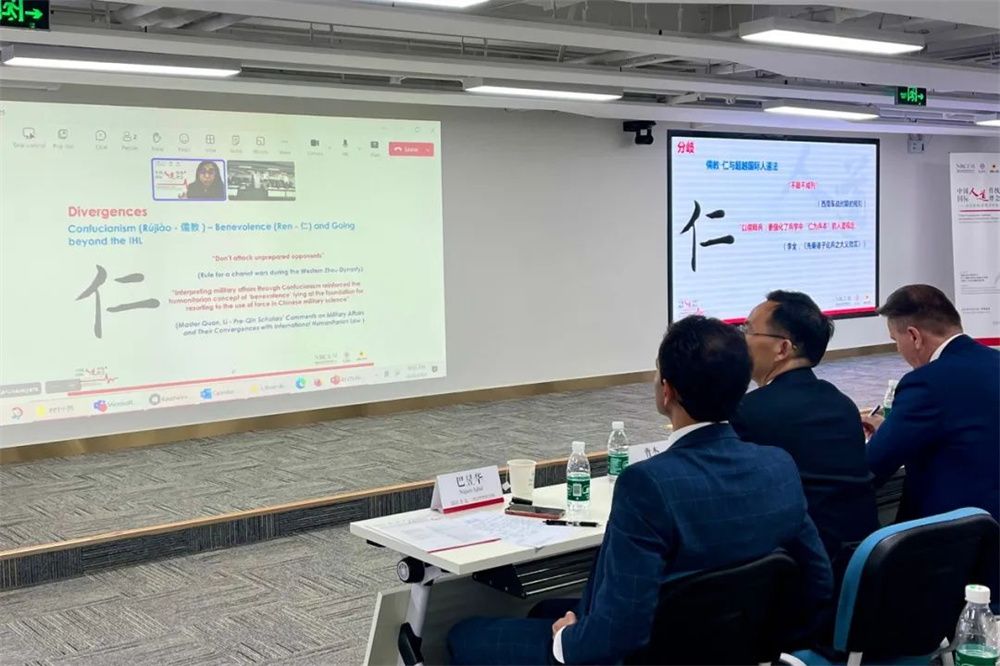
The seminar on“Chinese Humanitarian Traditions and International Humanitarian Concepts” was held in Beijing, October, 2024. Kaushalya Karunasagara, advisor of the International Committee of the Red Cross (Sri Lanka) delivered a speech online.(CNS)
CNS: Are the ideas such as “ren ai” and “shu dao” that have had a profound impact on China and the Asian region also reflected in the Geneva Conventions? How are they applied in international humanitarian action?
Kaushalya Karunasagara: The Geneva Conventions signed in 1949 were the result of joint deliberations by countries around the world, drawing on a wide range of human cultural traditions. China was one of the earliest countries to sign the Geneva Conventions.
Several centuries before the adoption of the Geneva Conventions, Chinese cultural tradition had already prioritized “ren dao” in warfare, established rules for protecting civilians and civilian property, and emphasized the importance of treating the wounded and sick. Now, these principles constitute the core of international humanitarian law, which is also the cornerstone of the humanitarian mission of the International Committee of the Red Cross.
For example, The Art of War by Sun Tzu is renowned around the world, especially among military and political leaders. The Art of Waris a book about military strategy and the art of war. In the book, it is written that “treat captives with kindness and care, for this is called strengthening oneself while overcoming the enemy.” (The Art of War: Waging War). It emphasizes that prisoners of war must be treated humanely in any situation, which is consistent with the principles of “prisoner of war treatment” stipulated in the Geneva Conventions, such as allowing them to communicate with their families.
Another passage from in The Art of Waris written, “A skilled commander subdues the enemy’s forces without engaging in pitched battles, captures cities without launching direct assaults, and conquers states without protracted warfare. Such a leader upholds the principle of achieving complete victory without resorting to arms, thereby asserting dominance over the world.” (The Art of War: Attack by Stratagem) emphasizes that after seizing power, the victorious should not destroy the defeated country. This closely reflects the obligation under international humanitarian law to protect specific items and cultural heritage.
At a time when international humanitarian law is facing enormous pressure in multiple hotspots around the world, China’s humanitarian tradition, like international humanitarian law, clearly states that even war must be limited.
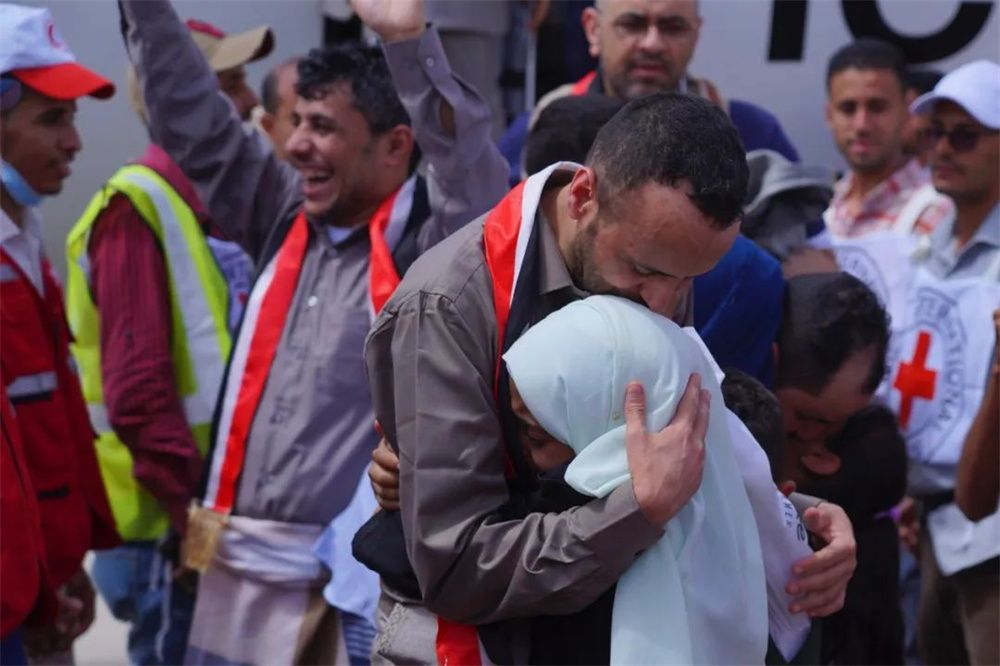
973 detainees related to the Yemen conflict were released and transported back to Yemen or Saudi Arabia by the International Committee of the Red Cross, April, 2023. The picture shows people embracing each other at Sana’a Airport.(Photo provided by the International Committee of the Red Cross)
CNS: What is the practical significance of drawing wisdom from Eastern culture for the international humanitarian cause in today’s world?
Kaushalya Karunasagara: When armed conflicts erupt in reality, adhering to international humanitarian law can make the path to peace more accessible.
The International Committee of the Red Cross has been tirelessly promoting respect for and compliance with international humanitarian law, emphasizing that all countries have an obligation to promote international humanitarian law. By paying attention to cultural traditions, we emphasize that international humanitarian law is rooted in these diverse traditions and remind people to abide by humanitarian goals.
In our experience, philosophy, religion, and cultural traditions directly or indirectly play important roles in shaping values, ethics, and beliefs. When exploring the commonalities between these traditional ideas and international humanitarian law together, people are more likely to start seeing international humanitarian law as a reflection of their own value system.
The key is that people gradually understand that international humanitarian law is not a set of “foreign and unfamiliar rules”, but a part of our culture and traditional values that have long been present.

Kaushalya Karunasagara. (Photo provided by the interviewee)
Kaushalya Karunasagara is a Partner Network Advisor for the International Committee of the Red Cross Sri Lanka Representative Office. She has been dedicated to academic research on multiculturalism for many years, focusing on and promoting “international humanitarian law” and “human rights law” from an Asian cultural perspective. Her latest research report, “Rules and Traditions During Conflict Situations: contextualizing IHL with Chinese Humanitarian Traditions” ,was presented at the “Chinese Humanitarian Traditions and International Humanitarian Concepts” themed seminar jointly organized by the International Committee of the Red Cross, the Chinese Red Cross Society, and the National Emergency Medical Research Center.
